The Best Free Auto-Tune Alternative? I Measured Mine Against the $450 One.
THE_PITCH 2 MINI is free pitch correction. I measured it against AutoTune Advanced, the 2026 release by Antares ($450), on 65 real vocal takes: 70 measurements, ahead on 56, level on 13, behind on 1. The method, every number, and the one result that goes against me.
Ask anyone to name a pitch correction plug-in and you get the same answer: Auto-Tune. AutoTune Advanced, the version Antares released in 2026, costs $450. It set the standard, and it earned that.
So when I built THE_PITCH 2 MINI, I didn't aim for "good for a free plug-in". I picked the one everybody knows and made it the bar:
It doesn't ship until it beats Auto-Tune. Measured, not felt.
Then I made it free.
The short answer
THE_PITCH 2 MINI 1.0.0 against AutoTune Advanced 1.0.0 (2026), on 65 real vocal takes and 70 measurements: ahead on 56, level on 13, behind on 1.
- Ahead: it lands closer to the note, sits on a wrong note less often, stays on the notes of your key for more of the time, stutters less and leaves the S and T sounds alone.
- Level: mostly new clicks, plus a few measurements at the two ends of the dial in the recording mode.
- Behind: wrong notes at hard tune in the recording mode, 1.90% against 1.69%. One click turns that around. More on it below.
And it keeps the same amount of vibrato as Auto-Tune at every speed. So it isn't winning by tuning harder.
THE_PITCH 2 MINI vs Auto-Tune: the numbers
Two pairings, because you use pitch correction in two situations. Recording: THE_PITCH 2 MINI in LIVE against AutoTune Advanced in Low Latency. Mixing: STUDIO against HQ. Every number is the average over the same 65 takes. THE_PITCH 2 MINI is the first number, AutoTune Advanced the second.
Mixing: STUDIO against HQ
| What you care about | Hard tune | 25 ms | 50 ms |
|---|---|---|---|
| Pitch error, cents (lower is better) | 1.2 / 4.1 | 12.9 / 14.8 | 15.3 / 20.4 |
| Wrong notes, % of the time (lower is better) | 1.54 / 1.70 | 1.05 / 1.81 | 1.10 / 1.92 |
| On the notes of the key, % of the time (higher is better) | 90.9 / 86.0 | 79.5 / 71.7 | 73.8 / 65.3 |
| Stutter, per second (lower is better) | 0.56 / 0.87 | 0.55 / 0.83 | 0.54 / 0.74 |
| New clicks per take (lower is better) | 0.02 / 0.11 | 0.02 / 0.08 | 0.02 / 0.03 |
| S and T sounds changed, dB (lower is better) | 0.0 / 1.1 | 0.0 / 1.0 | 0.0 / 1.0 |
Recording: LIVE against Low Latency
| What you care about | Hard tune | 25 ms | 50 ms |
|---|---|---|---|
| Pitch error, cents (lower is better) | 4.0 / 4.1 | 13.9 / 14.9 | 19.3 / 20.5 |
| Wrong notes, % of the time (lower is better) | 1.90 / 1.69 | 1.51 / 1.80 | 1.52 / 1.80 |
| On the notes of the key, % of the time (higher is better) | 86.4 / 86.2 | 76.6 / 71.5 | 70.0 / 65.3 |
| Stutter, per second (lower is better) | 0.49 / 0.80 | 0.46 / 0.74 | 0.46 / 0.76 |
| New clicks per take (lower is better) | 0.03 / 0.03 | 0.03 / 0.02 | 0.03 / 0.02 |
| S and T sounds changed, dB (lower is better) | 0.0 / 1.1 | 0.0 / 1.1 | 0.0 / 1.1 |
Bold marks a lead that holds across the 65 takes with 95% confidence. The tables show three of the five speeds. The 10 ms and 100 ms rows follow the same pattern and are counted in the 70.
What the numbers mean:
- Pitch error: how far the output sits from the note it should be on, in cents. 100 cents is one semitone. At slower speeds this number goes up for every tuner, on purpose: a slow setting lets the singer's movement through.
- Wrong notes: the share of the time the output is pulled toward a note the singer didn't mean. This is the one you hear as a "glitch".
- On the notes of the key: the share of the time the output is within 25 cents of a note in your key.
- Stutter: short dips in level that the correction adds. You hear them as a rough, grainy edge on held notes.
- New clicks: clicks in the output that were not in the recording.
- S and T sounds: how much the level of the sibilants changes. A tuner has no business touching an "s". It has no pitch.
How I made the test fair
Rule 1: real singers, not test tones. A tuner that's perfect on a sine wave tells you nothing. The 70 measurements come from 65 untuned phrases out of 33 real vocal recordings: different singers, different microphones, breaths, creaks and all. A set of synthetic melodies with an exactly known pitch runs next to it as a cross-check. Nothing is behind there either.
Rule 2: the same dial position means the same thing. Tune harder and you'll always be "more in tune", and you'll also flatten the singer. So both plug-ins run at the same retune speed, and I checked what that does to the vibrato:
| Vibrato kept at | 10 ms | 25 ms | 50 ms | 100 ms |
|---|---|---|---|---|
| THE_PITCH 2 MINI | 41 to 44% | 72 to 74% | 83 to 86% | 91% |
| AutoTune Advanced | 40% | 72 to 74% | 86 to 87% | 90% |
Same speed, same amount of singer left in the take. Whatever is better at that point is better tuning, not more tuning.
Rule 3: measure Auto-Tune at its strongest. The 70 measurements use AutoTune Advanced as it loads, with its Modern algorithm. But one setting can flatter whoever is compared against it. So on the 30 phrases with a known key, I also ran it at eleven other settings, one change at a time: Tracking, Flex-Tune, the Classic algorithm and more. None of them beats its own default across the meters. Against every one of them, the picture is the same.
Rule 4: a lead only counts if it's real. Each of the 70 measurements compares the two plug-ins take by take. It only counts as ahead, or behind, when the difference holds across the 65 takes with 95% confidence. Everything else is called level, even when my number is the better one.
Both get the same takes, the same key and the same scale. AutoTune Advanced runs as the installed VST3. Each output is lined up in time with the input before anything is measured.
What the lead is made of
It lands on the note
At hard tune, the STUDIO output sits 1.2 cents from the note. AutoTune Advanced in HQ sits 4.1 cents away. And at every speed above hard tune, in both modes, THE_PITCH 2 MINI is on the notes of your key for 4 to 8 points more of the time.
Fewer wrong notes at the speeds you actually use
Most vocals are not hard tuned. They sit somewhere around 25 to 50 ms, where the tuning should be there without being heard. That's exactly where a tuner grabbing the wrong note hurts most.
At 25 ms in STUDIO, THE_PITCH 2 MINI is on a wrong note 1.05% of the time. AutoTune Advanced: 1.81%. At 50 ms it's 1.10% against 1.92%.
No stutter, no chewed consonants
A corrected vocal can pick up a grainy edge on held notes. THE_PITCH 2 MINI stutters 0.45 to 0.56 times per second across all speeds, AutoTune Advanced 0.69 to 0.87.
And the "s" and "t" sounds: AutoTune Advanced changes their level by about 1.1 dB at every speed. THE_PITCH 2 MINI changes them by 0.0 dB. It leaves what has no pitch alone.
The one measurement Auto-Tune takes
Hard tune, recording mode. In LIVE, THE_PITCH 2 MINI sits on a wrong note 1.90% of the time. AutoTune Advanced in Low Latency: 1.69%.
I looked at where those moments are. They sit at note changes, when a singer glides across the halfway point between two notes, and they sit in the phrases corrected chromatically, where every semitone is allowed and the next wrong note is always close:
| Wrong notes at hard tune | THE_PITCH 2 MINI | AutoTune Advanced |
|---|---|---|
| LIVE against Low Latency, all 65 takes | 1.90% | 1.69% |
| LIVE against Low Latency, the 30 takes with a key set | 1.08% | 1.03% |
| STUDIO against HQ, all 65 takes | 1.54% | 1.70% |
So there are two ways out, and each is one click:
- Set the key. Pick it, or hit DETECT KEY and let the plug-in find it from your vocal. With a key set, the two are level.
- Switch to STUDIO for the mix. There THE_PITCH 2 MINI is ahead.
One job, done right
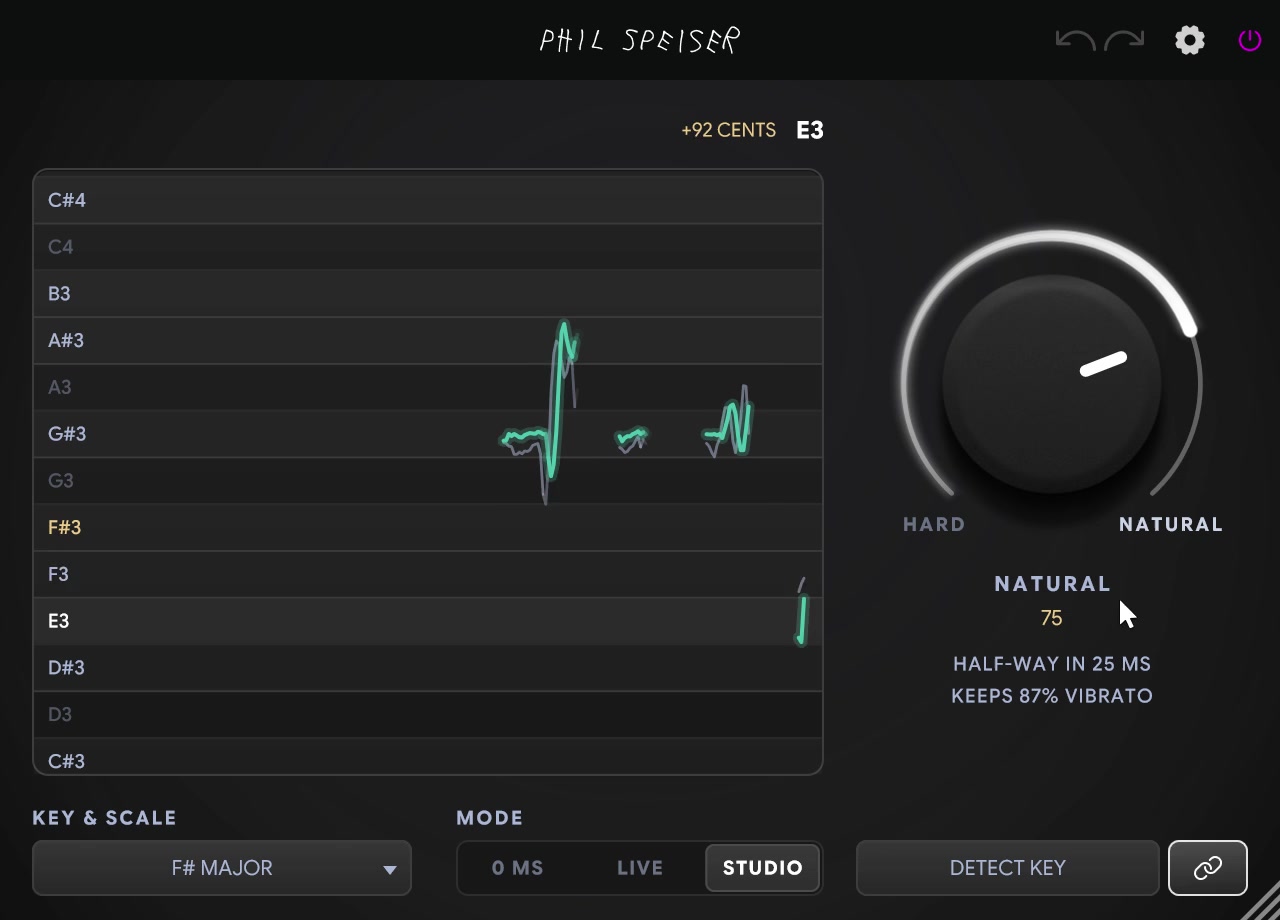
THE_PITCH 2 MINI does one thing: you pick a key, turn one dial from HARD to NATURAL, and it tunes. That's the part of Auto-Tune I measured, and the part most vocals need.
And it corrects one melody line at a time: a voice, a lead, a solo instrument. Not chords.
Why is it free?
Because at its core, pitch correction is an algorithm. A mathematical formula. It took me years to get this one right, and sooner or later AI will nail algorithms like mine too.
So I'm not going to charge you for math. What I want you to pay me for is everything I build around it: a music production world that makes you feel something and keeps the ideas coming.
THE_PITCH 2 MINI is the algorithm. It's yours.
And it still got a few things I always wanted in a pitch correction plug-in and never had:
- A lane that shows every note you sing, in grey, and where it's being sent, in colour.
- A dial that tells you what it does in plain numbers: how fast a note lands, how much vibrato stays.
- DETECT KEY, when you don't know what key the song is in.
- LINK, so every THE_PITCH 2 MINI in your session shares one key, together with THE_INSTRUMENT 3. Change it in one, the others follow.
- LEAN, for the one note the automatic pick gets wrong. Automate it to UP or DOWN and that note goes to the next note above or below instead.
- NOTE, when you know exactly where a note belongs. Automate it to any note from C to B and the voice lands there.
- Three modes: 0 MS with no latency at all for hard tune while you perform, LIVE at 2 ms to sing through, STUDIO with 50 ms of lookahead for the mix.
VST3 and AAX on Mac and Windows, AU on Mac.
Run the test yourself
Don't take my word for it. THE_LAB, my free measurement app, has a pitch correction test. Run your own vocal through Auto-Tune, through THE_PITCH 2 MINI, or through any tuner you own, and it reads the result with its own pitch meter: notes left off the note, notes pulled to the wrong one, flicker, how fast it lands and the clicks it adds.
Or just put both on the same take, at the same speed, and listen.
Think another pitch correction plug-in deserves the title? Tell me which one. It goes through the same 65 takes, and the result goes on this page.
The $450 standard, measured. Ahead on 56 of 70. Free.
How I measured this
- Material
- 65 untuned phrases from 33 real vocal recordings by different singers. 30 phrases have a known key and are corrected to that key, 35 are corrected chromatically
- A second set of synthetic melodies with an exactly known pitch (note steps, scoops, vibrato, slow drift, low rough and high airy voices) as a cross-check. Nothing is behind there
- Versions
- THE_PITCH 2 MINI 1.0.0 by Phil Speiser, free
- AutoTune Advanced 1.0.0 by Antares (Auto-Tune), released in 2026, $450 perpetual license at the time of the test
- Measured on
- 2026-11
- Settings
- Two pairings by purpose. For recording: THE_PITCH 2 MINI in LIVE against AutoTune Advanced in Low Latency. For mixing: THE_PITCH 2 MINI in STUDIO against AutoTune Advanced in HQ
- Five retune speeds on both plug-ins: 0 (hard tune), 10, 25, 50 and 100 ms. Both dials mean the same thing, and the vibrato each one keeps at each speed confirms it: 40 to 44% at 10 ms, 72 to 74% at 25 ms, 83 to 87% at 50 ms, 90 to 91% at 100 ms
- AutoTune Advanced as it loads: Modern algorithm, Humanize 0, Flex-Tune 0, every other control at its default. Same key and scale on both plug-ins
- Seven meters per scenario: pitch error, wrong notes, on-grid time, stutter, new clicks, and two sibilant meters. 2 pairings x 5 speeds x 7 meters = 70 measurements
- A measurement counts as ahead or behind only when the difference holds across the 65 takes with 95% confidence (paired bootstrap). Everything else is level
- Held constant
- The same 65 takes through both plug-ins, the same key, scale and retune speed, AutoTune Advanced running as the installed VST3. Each output is aligned in time with the input before it is measured
- Notes
- On the 30 phrases with a known key I also ran AutoTune Advanced at eleven other single settings (Tracking, Flex-Tune, Classic and more). None of them beats its own default across the meters, and THE_PITCH 2 MINI gives the same picture against each
- The intended note is the nearest allowed note to where the singer is centred. At speeds above 0 only the time after a note has had four times the retune speed to settle is graded, so a slow setting is never punished for doing what the dial says
- AutoTune and Auto-Tune are trademarks of Antares Audio Technologies. I am not affiliated with Antares
FAQ
What is the best free Auto-Tune alternative?
THE_PITCH 2 MINI by Phil Speiser is a free pitch correction plug-in that was measured directly against AutoTune Advanced 1.0.0 by Antares (released 2026, $450). On 65 real vocal takes and 70 measurements it is ahead on 56, level on 13 and behind on 1. It has one dial from HARD (the hard-tune effect) to NATURAL, key and scale selection, key detection, a zero-latency mode for recording and runs as VST3, AU and AAX on Mac and Windows.
Is THE_PITCH 2 MINI better than Auto-Tune?
On the measurements, yes for automatic pitch correction. Against AutoTune Advanced 1.0.0 by Antares (released 2026), on 65 real vocal takes at five retune speeds, THE_PITCH 2 MINI 1.0.0 is ahead on 56 of 70 measurements, level on 13 and behind on 1. At hard tune in STUDIO its output sits 1.2 cents from the note against 4.1 cents, it stutters less at every speed (0.45 to 0.56 against 0.69 to 0.87 per second) and it changes the S and T sounds by 0.0 dB against about 1.1 dB.
Is THE_PITCH 2 MINI really free?
Yes. THE_PITCH 2 MINI costs 0. It is not a trial and not a subscription. You get it from philspeiser.com and download it from your account, for Mac and Windows.
Where is AutoTune Advanced better than THE_PITCH 2 MINI?
On one of 70 measurements: in the low-latency recording mode at hard tune, AutoTune Advanced sits on a wrong note 1.69% of the time against 1.90% for THE_PITCH 2 MINI in LIVE. With a key set the two are level (1.03 against 1.08%), and in STUDIO THE_PITCH 2 MINI is ahead (1.54 against 1.70%).
Can a free plug-in do the hard-tune effect?
Yes. Turn THE_PITCH 2 MINI's dial all the way to HARD and every note snaps to the key with no vibrato left. Measured at hard tune on 65 real takes, its STUDIO mode lands 1.2 cents from the note and stays within 25 cents of a note in the key 90.9% of the time, against 4.1 cents and 86.0% for AutoTune Advanced in HQ.
Can I record through THE_PITCH 2 MINI without latency?
Yes. The 0 MS mode reports no latency to your DAW and passes the sound in 0.2 ms. LIVE adds 2 ms and is the mode to sing through. STUDIO looks 50 ms ahead for mixing and your DAW compensates the delay.
Does THE_PITCH 2 MINI keep the vibrato?
As much as you let it. At the same retune speed it keeps the same share of the singer's vibrato as AutoTune Advanced: about 41 to 44% at 10 ms, 72 to 74% at 25 ms, 83 to 86% at 50 ms and 91% at 100 ms, against 40%, 72 to 74%, 86 to 87% and 90%. The dial also shows you the number while you turn it.
Does pitch correction damage the S and T sounds?
It can. On the sibilants of 65 real takes, AutoTune Advanced changed the level of the S and T sounds by about 1.0 to 1.2 dB at every retune speed. THE_PITCH 2 MINI changed them by 0.0 to 0.1 dB, because it leaves unpitched sounds alone.
How was THE_PITCH 2 MINI compared with AutoTune Advanced?
The same 65 untuned phrases from 33 real vocal recordings went through both plug-ins at the same key, scale and retune speed (0, 10, 25, 50 and 100 ms). THE_PITCH 2 MINI in LIVE was compared with AutoTune Advanced in Low Latency, and STUDIO with HQ. Seven things were measured on each output: pitch error, wrong notes, time on the grid, stutter, new clicks and two sibilant meters. A measurement counts as ahead or behind only when the difference holds across the takes with 95% confidence.
Which formats and systems does THE_PITCH 2 MINI support?
VST3 and AAX on Mac and Windows, plus AU on Mac.