How to Master Loud Without Losing Dynamics: A Complete Guide to Avoiding Overcompression
Learn why loud masters sound flat and how to avoid overcompression. Discover the key metric for dynamic, punchy masters that win on streaming platforms.
Your LUFS meter is lying to you. Not about loudness - it's doing that job fine. But it's telling you nothing about whether your master actually sounds good.
I've seen producers push their limiters to -6 LUFS and wonder why the track sounds dead. The number went up, the waveform became a brick, and somehow the energy went down. That's because loudness and punch aren't the same thing.
The Loudness Wars Are Over
For decades, every new release tried to out-volume the competition. Louder sounds better in A/B comparisons, so the industry just kept pushing. What we gave up was everything that makes music feel alive: the crack of snares, the thump of kicks, the breathing room between sections.
Streaming changed the game. Spotify, Apple Music, and YouTube all use loudness normalization - they measure every track and adjust playback so everything hits roughly -14 LUFS. A track mastered to -6 LUFS gets turned down 8 dB. A track mastered to -14 LUFS with healthy dynamics plays back untouched, with all its punch intact.
The math is simple: if your -6 LUFS master has 4 dB of dynamic range and is turned down to -14 LUFS, it'll sound weaker than a -14 LUFS master with 10 dB of dynamic range. Same playback level, but one has snap and body, the other sounds like cardboard.
Normalization rewards dynamics, not volume. After the algorithm does its thing, the track with more transient impact sounds louder than the one that measured higher on the meter.
What Actually Measures "Too Compressed"?
LUFS tells you how loud. But what tells you if you've gone too far?
The gap between your peaks and your loudness.
Think of it like headroom in a car. Your peaks are your head, your loudness is the roof. If there's only 3 dB between them, you're hitting the ceiling with every transient. Your drums can't punch. Your accents can't pop.
| Dynamic Range | Status | What You're Hearing |
|---|---|---|
| Under 4 dB | Crushed | Distorted, brittle, fatiguing. Snares have no crack. Kicks are all sustain, no thump. Everything bleeds together. |
| 4-6 dB | Squashed | The limiter is pumping. You can hear it working. Some transients poke through, but the glue has become cement. |
| 6-9 dB | Dense | Warm and controlled. Works for aggressive genres, but you're trading snap for sustain. The body is there, the crack isn't. |
| 9-12 dB | Healthy | The sweet spot. Kicks have both thump and body. Snares crack without getting buried. The mix breathes. |
| 12+ dB | Punchy | Maximum transient impact. You hear every hit. Great for acoustic, jazz, or anything where the performance is the point. |
Now, a caveat: sometimes crushed is exactly what you want. Hyperpop thrives on that blown-out, slammed-to-the-wall sound. Dubstep drops often live in the red on purpose. The danger isn't compression itself - it's compression by accident. If you're in the red and you meant to be there, cool. If you're in the red because you didn't realize what you were doing, that's a problem.
Same loudness, completely different impact. Two masters at -14 LUFS can sound worlds apart. One with 4 dB of range sounds flat. One with 10 dB sounds powerful and professional.
Dynamic Targets by Section
A single number for your whole track misses the point. Different sections need different treatment, and the contrast between them is what creates impact.
Intros, Outros, Breakdowns: 10-14 dB (Punchy to Healthy)
Let these sections breathe. The space you create here is what makes your drops hit harder. If your breakdown is already dense, there's nowhere to go.
Verses: 8-12 dB (Healthy)
Maintain clarity in the vocals while keeping energy. You want presence without fighting for attention.
Choruses and Drops: 6-10 dB (Dense to Healthy)
These can be denser - that's where the energy lives. But don't sustain anything below 6 dB for long stretches. Brief moments in orange are fine; camping there causes fatigue.
Build-ups: 8-12 dB, dropping to 6-8 right before the drop
Compression creates tension. Let the build get denser as it rises, then release into the drop. The contrast sells the moment.
Genre Matters
Not every genre lives in the same zone:
-
Classical, Jazz, Acoustic: 12-16 dB. The performance is the point. Preserve it.
-
Rock, Pop: 8-12 dB. Punchy but controlled.
-
EDM, Hip-Hop: 6-10 dB. Denser is acceptable - these genres thrive on energy.
-
Intentionally slammed masters (some metal, hyperpop): 4-6 dB. Squashed, but you meant it.
The key insight: what matters most is the contrast between sections, not hitting a specific number everywhere. A drop sitting at 8 dB will feel massive if your breakdown was at 12-14. That same drop will feel flat if everything around it is already at 8.
Seeing Dynamics in Real-Time with THE_METER
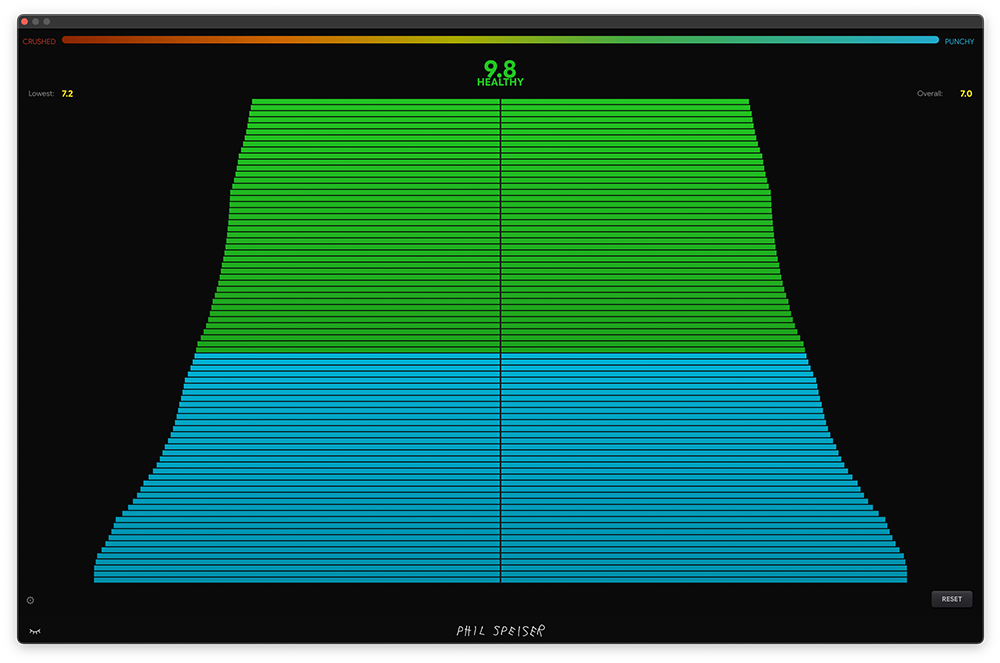
Numbers are useful, but visualization makes everything click. THE_METER's dynamics mode color-codes the ranges from the table above - red for crushed, orange for squashed, yellow for dense, green for healthy, cyan for punchy. No mental math required.
The real power is the waterfall history. As your track plays, you see a timeline showing how dynamics change through each section. That chorus that appeared fine? The waterfall could show it's dipping into orange while your verses stay healthy. You can catch problem sections before they sabotage your master.
Helpful Hints
A/B Your Limiter Settings
Hit Reset, play a section with your current limiter settings, and note the reading. Reset again, adjust the limiter, and play the same section. Now you have objective data on how each setting affects your dynamics.
Trust Your Ears, But Verify
Your ears should always be the final judge. But our ears adapt to loudness. After hours of mixing, -6 LUFS can start sounding "normal." The meter doesn't lie.