6 Things THE_EQ Does That No Other Equalizer Can
Most EQ plugins recycle the same features with a new UI. Here are six everyday mixing problems THE_EQ solves that no other equalizer on the market can touch.
Most EQ plugins recycle the same features with a fresh coat of paint and marketing jargon. New UI, same DSP, same workflow, same limitations. If you're tired of generic presets and cluttered routing, here's a straightforward look at six mixing problems THE_EQ solves that no other equalizer on the market can touch.
1. Sidechain Multiple Instruments — Zero Routing
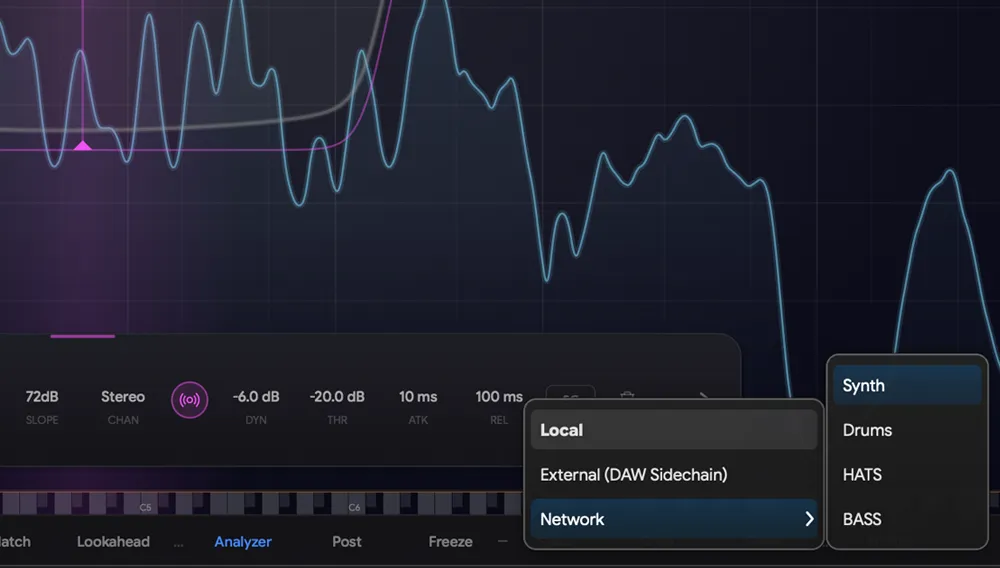
Here's how triggering dynamic EQ normally works: your EQ has one sidechain input. One. So if you want your synth pad to react to the kick on one band AND the vocal on another, you need multiple EQ instances, each with its own routing. It's a mess.
THE_EQ's network changes that completely. Because every instance sees every other instance, you can assign different triggers to different bands on the same track:
- Band 1 reacts to the kick
- Band 3 reacts to the vocal
Same plugin instance. No extra routing. No stacking EQs.
But it goes further. Right-click on a collision zone in the analyzer and hit Auto Unmask — THE_EQ creates a custom dynamic band, automatically sidechained to the competing track. Need a second instrument to trigger a second band? Same process, same plugin. You never leave the window.
These aren't static cuts. Each band is a fully dynamic EQ — it only ducks when the source instrument is actually present. When the kick isn't hitting, Band 1 does nothing. Your synth pad keeps its full low-end between kicks and its full mid-range between vocal phrases. The ducking is invisible to the listener.
2. Band Surfing — Your EQ Follows The Music
Music is not static. The pitch changes, and when pitch changes, frequencies change. So why are we still making static EQ cuts?
Band Surfing solves this. Toggle it on any band and it locks onto the dominant frequency of your audio in real time, riding the pitch as it moves. A ghost handle shows you exactly where the band is tracking while the EQ curve dynamically warps to match.
The most obvious use case: a bass line that moves across different notes. Put a low cut on it and enable Band Surfing. Now the low cut follows the bass — cleaning up below the fundamental no matter which note is being played. No automation. No guesswork. Your EQ literally follows the music.
This changes how you think about EQ. Instead of finding a compromise frequency that kind of works for every note, every band can be surgical on every note — automatically.
3. Linked Bands Across Tracks
You've got six vocal tracks — lead, doubles, ad-libs, harmonies. They all need the same low cut. They all need a bit more air in the highs. Normally that's six separate EQ moves, copy-pasted one at a time.
In THE_EQ, you select multiple instances in the sidebar by holding Shift, add a band on one of them, and it appears on all of them — linked. Change it on one, it changes on all. Even after you clear the selection, the link stays.
Need one track to do its own thing? Unlink it. The linked band becomes a normal independent band on that instance.
This is incredibly powerful for any group of tracks that share a role — vocals, drums, synths, background layers. Shape them as one unit, then fine-tune the exceptions. One move instead of six.
4. The Frequency Allocation Map
Traditional spectrum analyzers are almost useless for fixing frequency clashes. They're volume-dependent — a loud kick drum visually swallows the graph of a quieter bassline. You can see that something is loud at 80Hz, but you can't tell what's actually competing for the space.
THE_EQ ignores absolute volume and generates a proportional Frequency Allocation Map across every instance in your session. Instead of showing you what's loudest, it shows you what's competing — each track represented as a colored region, stacked proportionally across the spectrum.
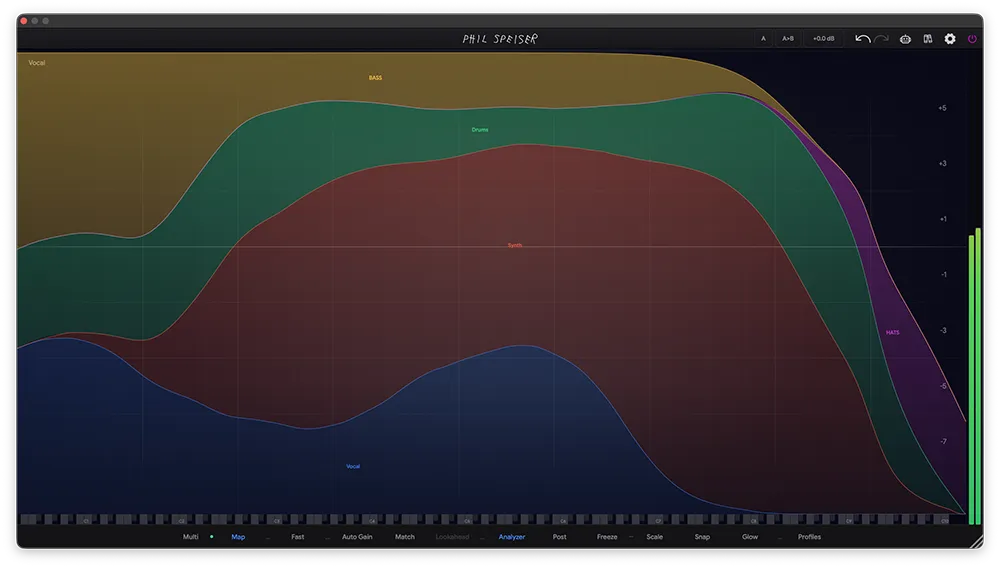
Here's a simple example: put only the kick and bass in view. You'll see they share most of the low-end space pretty equally. Now high-pass the bass — and watch the map change completely. The low frequencies are suddenly fully owned by the kick. You're watching your mix rebalance in real time.
Where colors overlap, tracks are fighting. Where one color dominates, that track owns the range. No guessing. No soloing back and forth. The full picture, one glance.
5. Smart Matching & Smart Profiles
Most EQ presets are useless because they don't know what else is in your mix. A "Vocal" preset was made for someone else's song. It doesn't know about your kick, your bass, or your synths.
THE_EQ offers two smarter approaches.
Smart Matching lets you match any track's EQ to a reference — and that reference can come from a sidechain input, from another instance in the network, or from an audio file. Let the plugin listen for a few seconds and it proposes an EQ curve that matches your track's tonal character to the reference.
Smart Profiles go further. They don't need a reference at all. The engine knows how a well-mixed vocal, piano, bass, guitar, drums, strings, or horns should sound — and it factors in all the other tracks in your session. Click Profiles, pick a category, let it listen, and it calculates a custom curve for your track in the context of your full mix. It even adds dynamic bands when it benefits the result.
This isn't a preset. It's a custom solution that only exists for your session.
6. An AI Assistant That Audits Your Actual Moves
Most "AI" mixing tools listen to your track, slap a generic EQ curve on it, and leave you in the dark. If it sounds wrong, you don't know why. If it sounds right, you learned nothing.
THE_EQ has a built-in assistant that reads your actual EQ settings — every band, every parameter, every routing choice. It doesn't override your decisions. It audits them.
Ask it: "Why does my bass still sound muddy?"
It doesn't give you a copy-pasted tutorial about low-end mixing. It looks at your specific instance and responds with something like:
"You boosted 250Hz by +10dB on Band 2. Pull that back to clear the mud."
The feedback is based on your exact parameters, not generic advice. You keep full control of the mix but get a second set of ears that catches the specific moves causing problems.
This is how you actually learn. Not by letting an algorithm make decisions for you, but by getting precise, actionable feedback on decisions you already made.