Clipping Is Saturation — So Why Use a Clipper and Not Just a Saturator?
Clipping is saturation — that's a fact. So why reach for a dedicated clipper instead of just pushing a saturator? Because this saturation has to be clean. Here's the measured proof THE_CLIPPER 1.1 produces 34–73 dB less aliasing than the two best-known clippers on the market.
Let's get one thing straight, because it trips up a lot of producers: clipping is saturation. That's not an opinion, it's a fact. A clipper is a nonlinear process that flattens your waveform and generates harmonics — the exact same family of distortion a saturator produces. Clipping is just the most extreme corner of it: instead of gently rounding the signal, it slices the tops clean off.
So here's the fair question, and it's the one worth answering: if clipping is just saturation, why reach for a dedicated clipper at all? Why not push any saturator until it clips and call it a day?
Because a saturator and a clipper have opposite jobs.
You load a saturator for its character — the warmth, the grit, the weight, the specific color the designer baked in. That character is the entire reason it exists. You want it.
You load a clipper for the opposite reason: to shave the peaks, buy headroom and loudness, and then get out of the way. It's saturation with a job to do — control the transients and add density without leaving fingerprints all over your mix. You want the flattening, and as little else as humanly possible.
That's the whole distinction. Not saturation vs. clipping — they're the same physics. It's character vs. transparency. A saturator is allowed to have a personality. A clipper's job is to have none.
And the moment a clipper adds its own uninvited character, it stops doing its job. That uninvited character has a name — aliasing — and it's the brittle, metallic, digital fizz that makes cheap clippers (and saturators pressed into service as clippers) sound cheap, especially on bright material: cymbals, vocals, distorted guitars, a loud master.
So the real difference between a great clipper and "just a saturator" isn't the harmonics — it's how little garbage comes with them. That's exactly what I set out to measure for THE_CLIPPER 1.1. Same sound. None of the digital garbage.
The two kinds of distortion in every clip
When a clipper flattens a waveform it manufactures a stack of new harmonics. That's the saturation — the intended part, mathematically related to the note, the sound you actually want.
The problem is that some of those harmonics land above half the sample rate (Nyquist). In the digital world they can't exist up there, so they fold back down into the audible band as inharmonic tones with no musical relationship to the note. That folded-back junk is aliasing.
So everything coming out of a clipper is one of two things:
- Harmonics (THD) — related to the note. Intended. This is the saturation you asked for.
- Aliasing — unrelated to the note. Never intended. This is character you didn't.
A saturator is allowed to be full of extra color, because color is why you loaded it. A clipper is not — its color should be nothing but the clip itself. Aliasing is the only honest measure of how clean a clipper actually is — so that's exactly what I measured.
How the test works (and why it's fair)
Everything below was measured in THE_LAB, my plugin measurement tool, using its HARMONICS analyzer. I built the test so there's nowhere to hide:
- Identical signal. A pure sine, generated on an exact FFT bin so the analysis is fully coherent. Folded aliases can never sneak onto a harmonic bin and disappear — they show up naked. 48 kHz, 65,536-point FFT.
- Identical clipping depth. Every plugin left at factory defaults, fed the same sine driven +6 dB past 0 dBFS, so all three clip the same amount of the waveform. I did not touch the rivals' settings.
- Proof the fight is fair. At 1 kHz all three land within 0.1 % of the same THD (~23.1 %). Identical harmonic distortion means identical clipping. The only variable left is aliasing.
That last point is the whole ballgame: when two plugins produce the same THD but one produces 40 dB less aliasing, that difference is entirely the quality of the anti-aliasing. Nothing else.
For the comparison I'm using two rivals — I'll call them Competitor 1 and Competitor 2. Both are well-known, well-respected clippers you'll recognise instantly. The point isn't to dunk on anyone; it's to show what the measurement reveals, on tools people already trust.
Fact 1 — 1 kHz: same harmonics, different garbage between them
At 1 kHz the harmonics fall inside the audible band, so you can see both the intended saturation and the aliasing in one picture. THE_CLIPPER is drawn upward; the rival is mirrored downward. The harmonic spikes line up perfectly — identical clip, identical sound. Now look at the floor between the spikes.
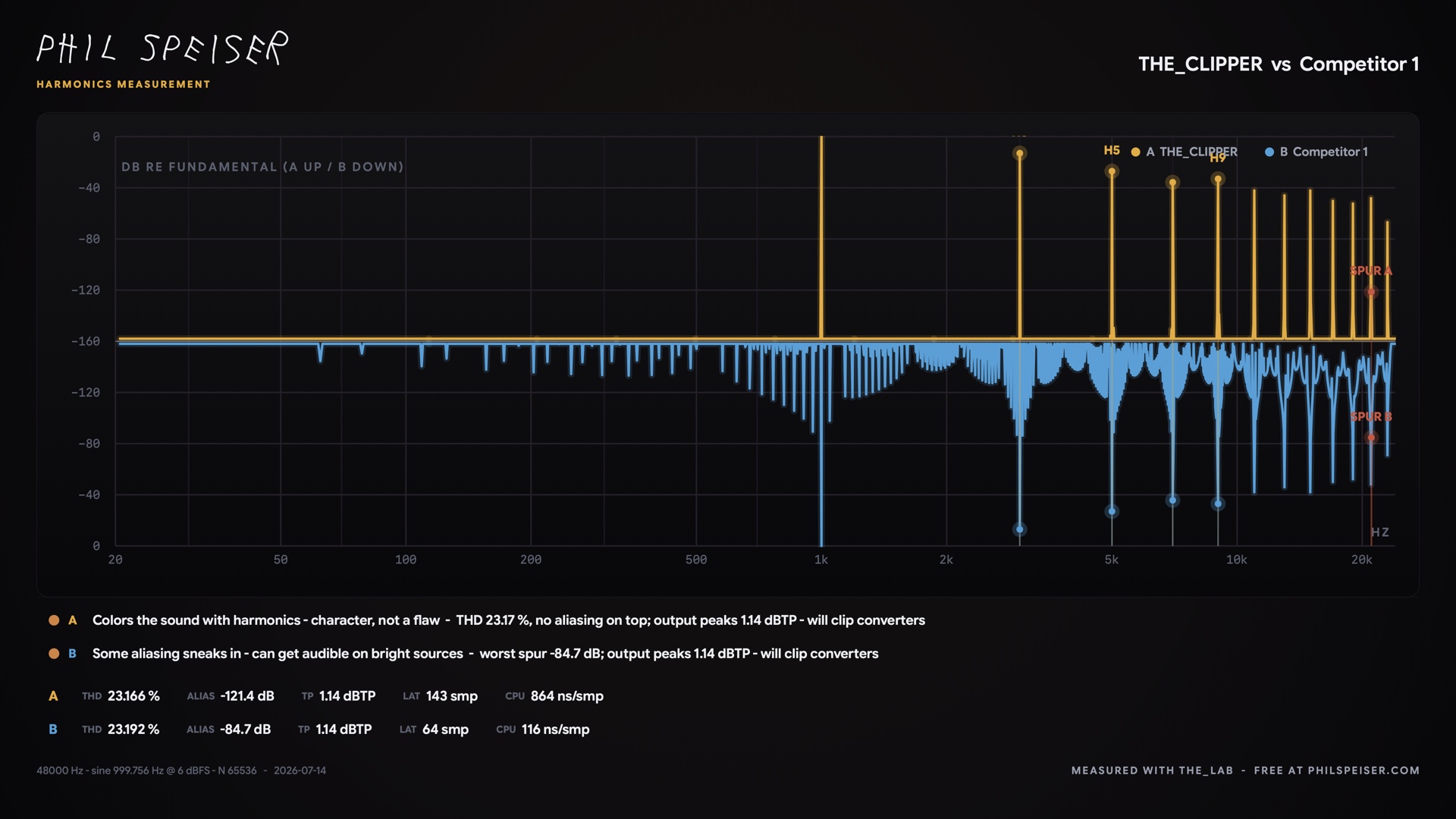
THE_CLIPPER's floor is flat and silent. The rival's is packed with aliasing — character it's adding to your track that you never dialed in.
| Plugin | THD (the sound) | Worst alias (the flaw) | THE_CLIPPER advantage |
|---|---|---|---|
| THE_CLIPPER | 23.17 % | −121.4 dB | — |
| Competitor 1 | 23.19 % | −84.7 dB | 37 dB cleaner |
| Competitor 2 | 23.09 % | −87.4 dB | 34 dB cleaner |
Fact 2 — 8 kHz: the torture test
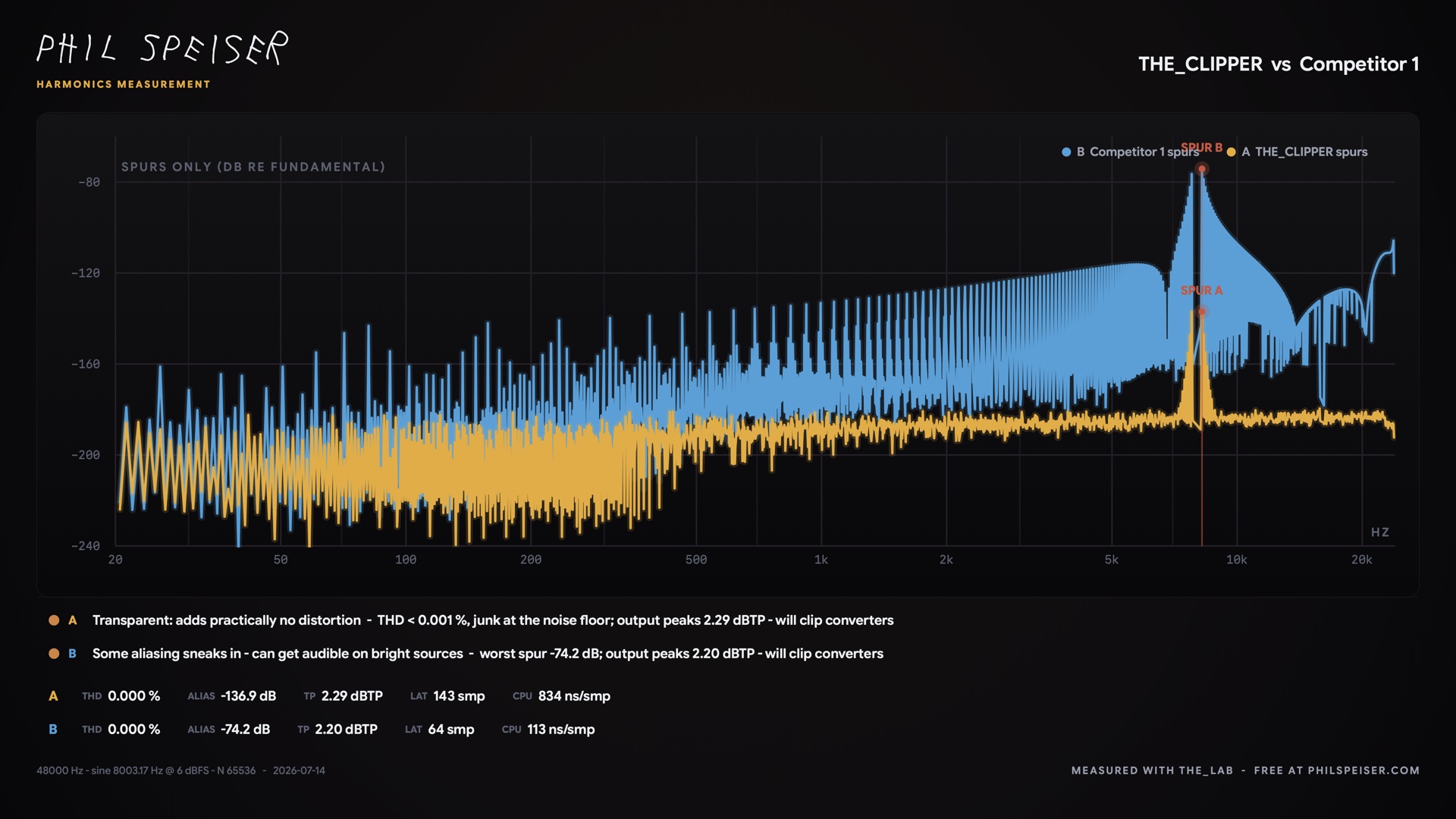
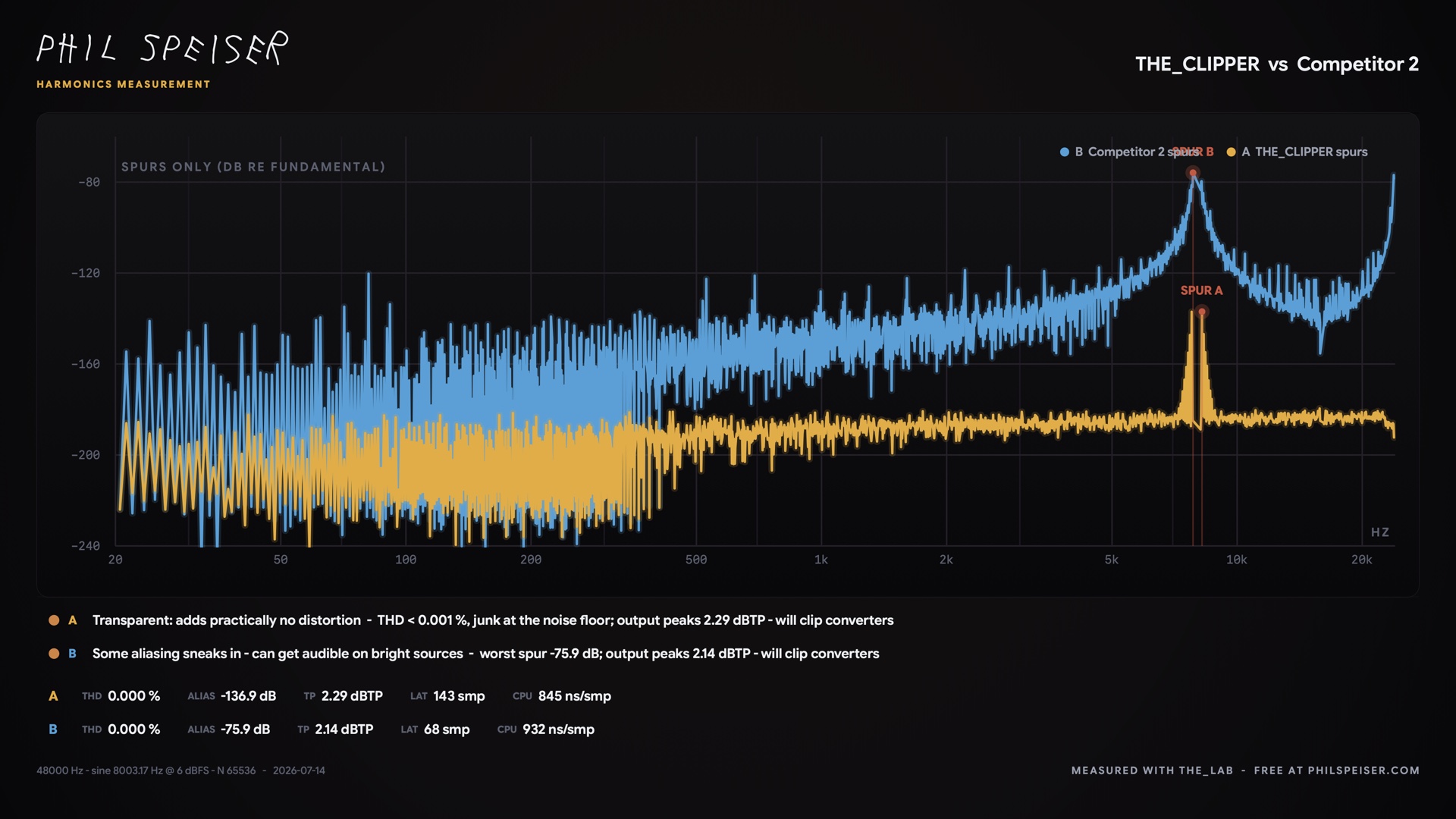
Push the tone up to 8 kHz and every harmonic a hard clipper makes lands above Nyquist. There's nowhere for the distortion to go except aliasing. This is where clippers get exposed — and where a bright master lives.
This next view is "spurs-only": the harmonics are masked out so you're looking only at the aliasing floor. Anything you see here is pure error.
| Plugin | Worst alias @ 8 kHz | THE_CLIPPER advantage |
|---|---|---|
| THE_CLIPPER | −136.9 dB | — |
| Competitor 1 | −74.2 dB | 63 dB cleaner |
| Competitor 2 | −75.9 dB | 61 dB cleaner |
THE_CLIPPER sits ~60 dB below the competition across the entire band. And the same story holds against the second rival — here's Competitor 2:
Fact 3 — slam it: the aliasing doesn't move
Here's the part that actually separates a great anti-aliaser from a merely good one. Drive the input harder and harder and watch what happens to the aliasing floor at 8 kHz:
| Drive into clip | THE_CLIPPER | Competitor 1 | Competitor 2 |
|---|---|---|---|
| +6 dB | −136.9 dB | −74.2 dB | −75.9 dB |
| +12 dB | −137.9 dB | −64.9 dB | −74.9 dB |
| +18 dB | −137.3 dB | −63.1 dB | −74.0 dB |
THE_CLIPPER's aliasing does not move. It's pinned at ~−137 dB no matter how hard you hit it. Competitor 1 gets audibly worse the harder you push — which is exactly when you reach for a clipper: loud masters, aggressive limiting, slamming drums. Against Competitor 1 slammed, the gap widens to 73 dB.
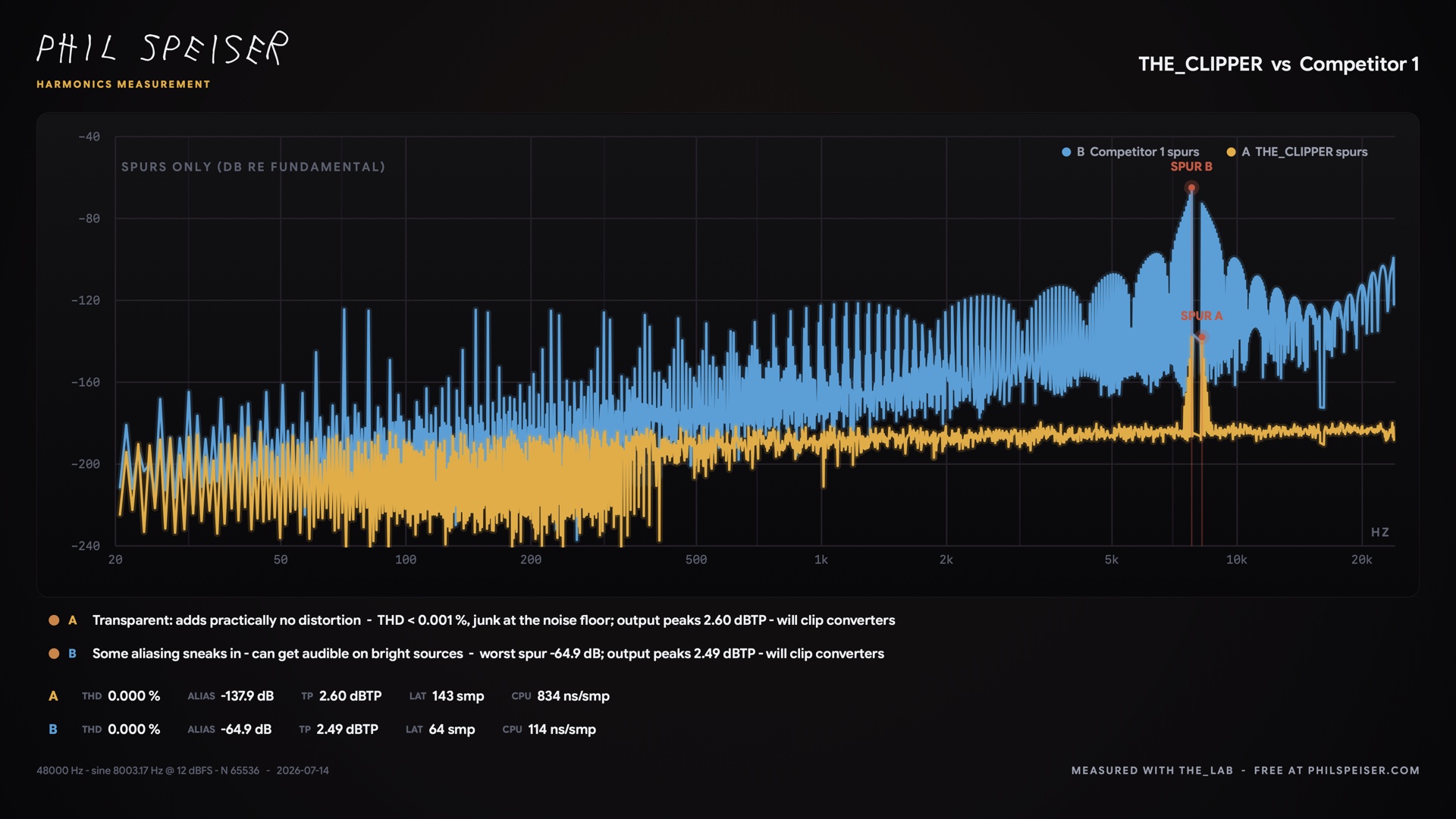
You push a clipper hardest on the loudest, brightest, most aggressive material — the exact situation where the other clippers smear the most uninvited character over your sound, and THE_CLIPPER doesn't budge. Drive it as hard as you want. The garbage never rises.
The honest tradeoffs
Cleanliness this deep isn't free, and I'd rather tell you the cost than pretend there isn't one:
- CPU. THE_CLIPPER runs heavy oversampling and steep anti-alias filtering: about 4 % of one CPU core at 48 kHz. Competitor 1 is much lighter (~0.5 %) — because it does far less anti-aliasing, which is why it aliases 60 dB more. Competitor 2, which oversamples similarly to THE_CLIPPER, actually costs slightly more CPU while still aliasing ~60 dB more. So against the plugin doing comparable work, THE_CLIPPER is both cleaner and cheaper on CPU.
- Latency. The anti-alias filtering adds latency — about 3 ms versus ~1.3 ms for the others. It's reported correctly to your host and fully compensated, but it's there.
- True peak. Like every clipper here, THE_CLIPPER can produce inter-sample peaks slightly above 0 dBFS. It ships a true-peak mode to catch them; the rivals behave the same by default.
Bottom line: you spend a few percent of a core and a couple of milliseconds to buy 30 to 70 dB less aliasing. On anything bright, that's the difference between "clean" and "digital."
Reproduce it yourself
I'm not asking you to take my word for it. Every number here was measured in THE_LAB: all plugins at factory defaults, identical coherent-sine stimulus, matched clipping confirmed by matched THD. Load your own clipper, run the same test, and look at the floor between the harmonics.
So: saturator or clipper?
Clipping is saturation — but not all saturation is a clipper. When you want character — warmth, grit, weight you can feel — reach for a saturator and enjoy every bit of color it adds. That's what it's for.
But when you're clipping to control peaks and get loud, you want that same saturation done one specific way: clean. Just the flattening, none of the fingerprints. That's the entire design goal of THE_CLIPPER, and 1.1 delivers it by a measured 34 to 73 dB — the same harmonics as the best clippers on the market, none of the digital garbage, and an aliasing floor that doesn't rise no matter how hard you slam it.
That's the difference between reaching for a saturator and reaching for a real clipper.
How I measured this
- Material
- Sine tones at 1 kHz and 8 kHz, driven +6, +12 and +18 dB past 0 dBFS
- Versions
- THE_CLIPPER 1.1 against the two best-known rival clippers, all at factory defaults
- Measured on
- 2026-07
- Settings
- Every plugin at factory defaults, fed the same sine at the same level, so all three clip the same amount of the waveform
- Harmonics and aliasing measured separately: THD for the wanted harmonics, spurs-only level for the aliasing
- Held constant
- Identical clipping depth and identical input; the rivals' settings were never touched
- Notes
- The rivals are anonymised as Competitor 1 and Competitor 2